Could Beowulf Have Been a Source for the Star Wars Lightsaber?

I’ve been reading my colleague Craig Williamson’s splendid new translation of Beowulf, the first time I’ve re-read this poem since college.  Coming across Craig’s fun discussion of compound words and “kennings” in Anglo-Saxon poetry (pp. 8-9; kennings are 2-word metaphorical descriptions of important things or concepts), a thought occurred to me:  could one of the sources of inspiration for the lightsabers in Star Wars have been the Old English epic poem?

I’ve never seen a mention of Beowulf as a source by Lucas, but of course he has acknowledged Joseph Campbell’s Hero With A Thousand Faces and J.R.R. Tolkien’s Lord of the Rings as inspirations.  Both might very well have led Lucas to read Beowulf, for it was a powerful source for both Campbell and Tolkien.   Beowulf has sometimes mentioned as a literary precedent for Star Wars, but when it is it’s usually by stressing such general things as the heroic quest, the battle between good and evil, etc.  Here’s another general plot parallel:  Beowulf gives the hero’s special sword a name, Hrunting, and stresses that all heroes fight with a particular, individual style.  Beowulf’s sword is given to him by another to honor Beowulf’s worth as a warrior, yet in Beowulf’s climatic fight with Grendel’s Mother Hrunting is not strong enough to kill the monster.  Such details have parallels with Lucas’ epic, which tried to give each lightsaber fighter a particular choreography, a distinctive style—for more on this, see the Wikipedia page on lightsabers below, especially the section on Choreography—and in Luke’s climactic battle with Darth Vader he too realizes he can’t defeat Darth solely by using his most trusted weapon.  As far as I can remember, though, Luke or other figures good and bad don’t name their lightsabers, though all the weaponry have distinctive features that individualize them.   Can anyone think of a named lightsaber in Star Wars?

But what about Lucas’ idea of the lightsaber itself?  Could that too have a source in a world long ago and far away?

Consider the famous kenning the poem uses for Beowulf’s sword:  hilde-leoma, “battle-light.”    In all of Old English literature, this hilde-leoma kenning occurs only in Beowulf, in two places.  The first is in line 1143 in the original (l. 1146 in the Williamson translation; the OE dictionary translates it as “battle-light” and Williamson renders this as “flashing sword”).  The second occurs in l. 2583 (2582 in the Williamson translation, where it’s rendered as “battle-flames”).  In this second instance, the kenning is of special interest because it describes both Beowulf’s sword and the dragon’s fire, which of course is its main weapon!  This kenning honors something fairly literal, of course: the flash of light on a fast-moving sword-blade.  But Beowulf is clearly battling the powers of darkness in the poem, standing for the light and the best of humanity, and so “light” here takes on much more than just a literal meaning—and it is a light that is linked via the compound metaphor to battling darkness.

Aside from Beowulf as a possible literary source of inspiration for Lucas, there are of course many more contemporary instances of powerful weapons involving beams of light etc. in twentieth century  sf  lore.  For a good survey of these with some fun pictures, see the “Star Wars Origins” website on lightsabers below.   But my hunch is the Lucas lightsaber has some very old origins as well.

PS: Thanks to Craig for some suggestions re this post.  He’s not responsible for my daffy ideas, of course!

Sources:

Craig Williamson, “Beowulf” and Other Old English Poems (Philadelphia:  U of Pennsylvania P, 2011).

Andy Orchard, A Critical Companion to “Beowulf” (New York: D.S. Brewer, 2005).

Joseph Bosworth and T. Northcote Toller.  1898.  An Anglo-Saxon Dictionary.  Rev. and Rpt.  London: Oxford UP, 1972.

Star Wars Origins” website, on the lightsaber.  http://moongadget.com/origins/lightsabers.html

Wikipedia Page on the Lightsaber   http://en.wikipedia.org/wiki/Lightsaber
 

Posted in Literature, Other (including pop culture of all kinds) | Tagged , , , , , | Leave a comment

Corpus of Historical American English (COHA)

Corpus of Historical American English (COHA).

The Corpus of Historical American English (COHA) is the largest structured corpus of historical English. The corpus was created at Brigham Young University, with generous funding from the US National Endowment for the Humanities. It is also related toother large corpora of English that we have created or modified.

COHA allows you to quickly and easily search more than 400 million words of text of American English from 1810 to 2009. You can see how words, phrases and grammatical constructions have increased or decreased in frequency, how words have changed meaning over time, and how stylistic changes have taken place in the language. It’s a lot more than just frequency charts for individual words and phrases (like with Google BooksCulturomics) — although those types of searches can be done here as well, and yield essentially the same results as Google Books.

Posted in Literature | Leave a comment

Comments on Samuel Barber’s “Summer Music for Wind Quintet”

Barber – Summer Music for Wind Quintet (Part 1) – YouTube.

A fine professional ensemble (Ensemble Wien-Berlin) handles this difficult but stunningly beautiful music–one of the very great wind quintets ever written.   See also Part 2 on YouTube (link below) for the conclusion of this piece.  Both posts, by the way, include the music so if you read music you can follow along!   Flute part is at the top, then oboe, then clarinet, then horn, then at the bottom bassoon.

Rightly called “Summer Music,” this piece evokes the ebullient energy of summer as powerfully as a poem like Wallace Stevens’ “Credences of Summer.”  This power is nicely captured by the bubbly arpeggios of the flute, clarinet, and bassoon, which often gurgle underneath the other music lines and, in other sections, are front and center, flowing leisurely in counterpoint.  They are optimistic, effervescent, confident of endless sunshine.   They dance.  At the end of the piece (in Part 2 in the YouTube excerpt) their notes fly upwards exuberantly like a flight of birds to make an end.  At times Barber sounds to my ear like he’s tipping his hat here and there to Stravinsky, especially his wind pieces from the 1920s, like the Octet.   And of course the lively ghost of Mozart hovers kindly in the background.  But it’s all also inimitably Barber’s own, especially because of what happens with the horn and oboe parts.

For all their liveliness, the horn and oboe parts speak often not of summer’s fullness but of something else that’s hard to name—something that’s definitely sounded in a minor key, not a major key.  The horn and oboe parts thus sometimes contrast with the bubbly excitement of the other winds, sounding against them, under them, beyond them.  Their notes are often long drawn out, not quick runs up and down the scale.  They evoke a different emotion and make me feel that before my eyes (and ears) a beautiful summer’s day is turning into evening.  It’s a counterpoint to pure effulgence, one that doesn’t negate it but makes such optimism all the more precious because its sunniness is cast against a darker backdrop.  Hard to put into words, but the horn and oboe parts make my eyes sting with tears just about every time I hear this piece.   Those plangent, minor, repeated held tones of the oboe and horn sound for me notes of loss and yearning, the music of the transcience of all things.  I hear and feel time passing.  This side of “Summer Music” is more like Stevens’ great elegy “Auroras of Autumn.”

I’m no musician, nor am I an expert commentator on music adept with all the techical knowledge and terms.   So I rely on analogies and metaphors to describe my reactions.  But they too are a part of what music does.  As I write this on an August evening, through the window I can hear crickets and in the distance the surf of traffic on a local highway….

Thank you szilszabee for posting this on YouTube!

Barber – Summer Music for Wind Quintet (Part 2) – YouTube.

This performance of Barber’s “Summer Music” by Ensemble Wien-Berlin is available on Sony CD, Twentieth Century Wind Music.

Posted in Classical Music | 1 Comment

On Nefertari’s Tomb in Egypt

Essay: Ankh, Snail, Blood, and Knot: A Virtual Tour of Nefertari’s Tomb (and its paintings).

For a video tour of the tomb, see the following.  But the essay above will allow you to think about some of the meanings in all the beautiful imagery underground: Nefertari’s Tomb. ANCIENT EGYPT – YouTube.


Posted in Art | Leave a comment

On Ruins and Prophecy

Ruins in the Eighteenth-Century Art of Panini and Others


Posted in Art | Leave a comment

excerpt from Jennifer Higden’s “Quiet Art” (for string quartet)

A lovely excerpt from the second movement, “Quiet Art,” of Jennifer Higdon’s “Impressions” string quartet, a great tribute to Ravel and Debussy and French painters. The second movement Higdon says is about “the solitude in which artists work, and the passion and consistency that help to create a work of art.”
http://www.jenniferhigdon.com/audio/Impressions/2-Quiet-Art.mp3


Posted in Classical Music | Leave a comment

Just got a new iPad. So guess which is the first book I finish reading on it?

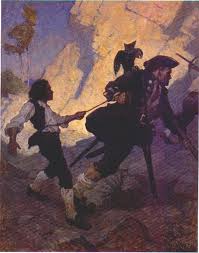
Turns out the first book I wanted to finish reading on our new iPad is a book that enchanted me when I was 12 and just becoming a serious reader—R. L. Stevenson’s Treasure Island. The free Kindle copy of the text doesn’t come with the magnificent N.C. Wyeth illustrations that so hypnotized me, but they’re easily viewable online too.   Guess I wanted my first extended use of our new futuristic device to involve a little travel back in time.

Re-reading now, I’m struck by how Treasure Island is not so much about a hunt for gold as it is a story of a young boy who’s lost his father — a boy who has to come to terms with adult hypocrisy and broken promises, foolishness, violence.   Of several figures competing to be Jim’s substitute father on the voyage, the one he can’t escape is one of literature’s most charming and deadly rogues–Long John Silver.   In Wyeth’s illustrations, and in the prose, the proper authority figures like Captain Smollett and the doctor all are done in studied greys; it’s the pirates who have flash and fire and are dangerously attractive.  Smollett has guts and talks well but disappears in the second half of the novel (he’s wounded); it’s Silver who gets the best dialogue and, without really intending to, teaches Jim not to trust appearances and to be daring.  Jim is literally tethered to him during one of the most dramatic episodes.  He has to become more like the pirates he hates and fears and yet is attracted to, while still keeping his eye on the steady compass-point of doing what he thinks is right.

How much of this I consciously absorbed at 12 is a real mystery to me; probably not very much.  I know I spent much more time trying to visualize what the treasure map looked like.  But call it (anachronistically) my Luke Skywalker moment.

Posted in Art, Literature | Leave a comment

Vijay Iyer Trio plays M.I.A.’s Galang (trio riot version) . – YouTube

Vijay Iyer Trio . Galang (trio riot version) . – YouTube.

Posted in Jazz and other music | Leave a comment