Climate Justice Requires Reparation, Abolition, and Decolonization
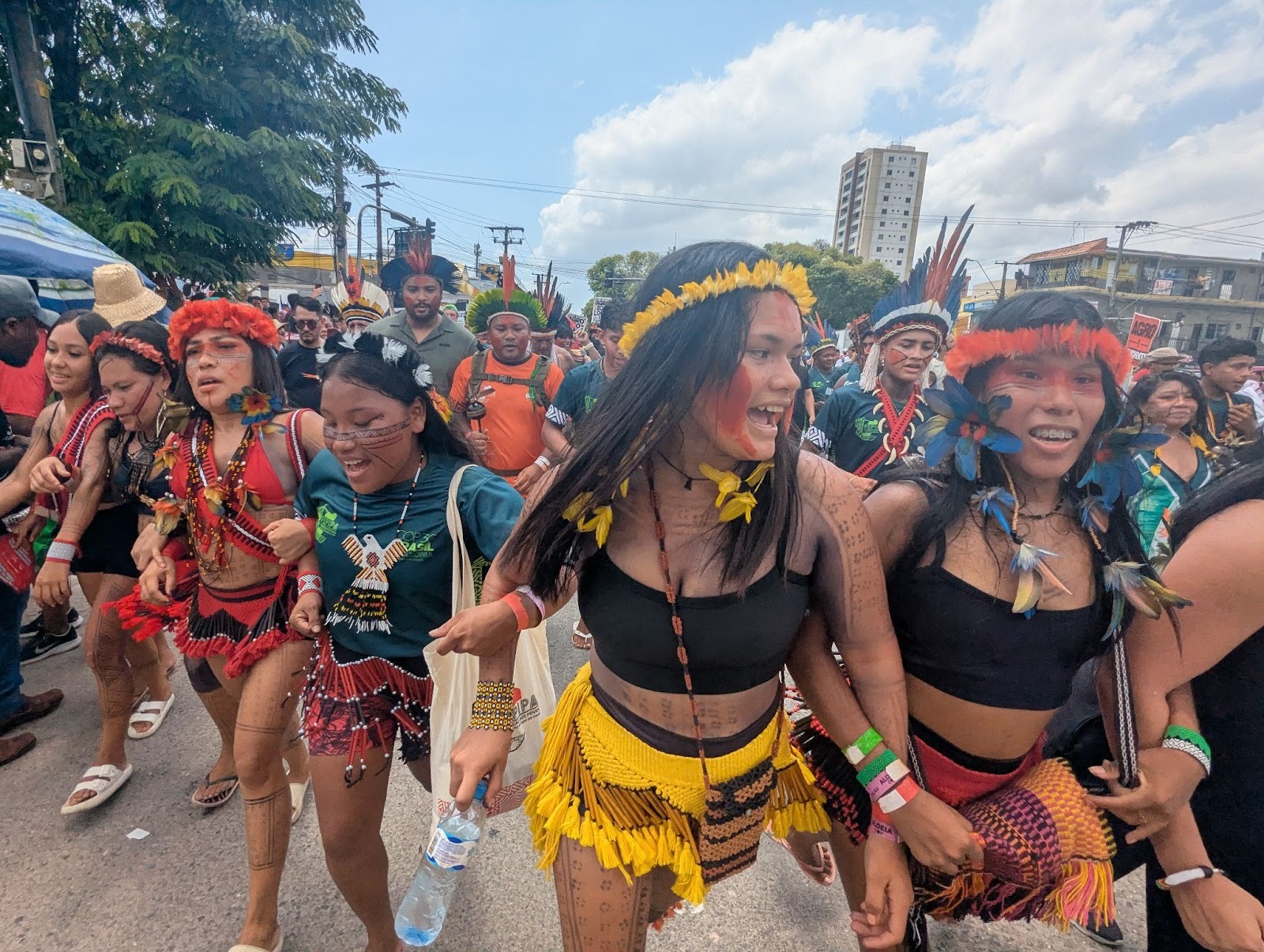
70,000 people marched through Belém do Pará demanding an end to “green capitalism,” denouncing COP30 as an ineffective method for delivering climate justice, and chanting the slogan, “we are the real solutions” on November 15, 2025. (Photo by the author.)
Michael Wilson Becerril
November 2025
Parades of heavily armed troops always within sight in the Amazonian city of Belém do Pará. Countless pavilions and panels promote nuclear energy, AI-driven solutions, and market mechanisms to solve the climate crisis. A well-dressed white man cuts in line for a free coffee, served in plastic cups. Colombian Vice President Francia Márquez declares unswervingly that “the UN system as a whole is a racist space.” These ethnographic data signal deep fissures at the heart of UN climate negotiations.
In a moment of consolidating global fascist oligarchy and multiplying crises, it is more clear than ever that climate justice requires reparations, abolitionism, and decolonization. This is crucial not only because climate change is already severely harming the marginalized communities least responsible for the problem, but also considering the co-opting forces that dominate the highest-level discussions about how humanity will respond to the crises of capitalism.
Climate Colonialism at COP
Despite decisive contestation by Indigenous, Afrodescendent, and marginalized communities inside and outside of the conference venue, the UN’s most recent Conference of Parties was a site of unchecked white supremacy, climate colonialism, and the continued selling out of the planet.
The drivers of the problem were presented as solutions at COP30, couched in rhetoric of “sustainable development” and a “green economy.” Tellingly, this has been the official rhetoric since the UN climate talks were first held in Río de Janeiro in 1992. What exactly has changed in this period?
Carbon emissions have nearly doubled (a result of an economic system that demands constant growth) and climate disasters are decimating vulnerable communities, causing millions of deaths and pushing us past the planetary boundaries identified by climate scientists. The world is increasingly unstable, characterized by growing fascism, militarism, and extractivism, all of which will only worsen our problems.
Marginalized people have been theorizing how deeply entwined these issues are, and their links to capitalism, for centuries (and even longer, since before these systems consolidated and had a name). As emphasized throughout the conference, most Indigenous communities have long understood that greed will strategically divide us for short term gain but consume us as a whole.
It is through the counter-conference spaces they have organized that the work of climate justice is happening: building solidarity, sharing ideas, growing networks, getting agitated, and bringing those things into action across their communities. Contrast this to the official conference, captured for years by polluting industries and, unsurprisingly, resulting this year in a statement that does not even name fossil fuels.
The making of the conference itself exhibited signs of environmental racism. As Dr. Adrião Oliveira noted, a sewage plant was built for wealthy conference guests in an impoverished, predominantly non-white neighborhood that does not itself have sewage services. Moreover, a highway to the conference was built through the territory of a Quilombo, a community established through struggle by self-liberated, formerly enslaved people and their descendants. Can the COP be reformed, when its very existence requires extractivism and when its contents mostly serve the interests of private plunderers, expanding the unequal status quo and derailing progress?
Angela Davis and others have argued that abolition is a world-making project, where we do not just destroy oppressive institutions but also replace them with new forms of relationships that effectively render them obsolete. For example, we would not only fight to close all jails and prisons but also build the kind of society where they are simply not needed anymore. Perhaps this is exactly what the counter-conference organizers are doing, resisting the capitalist false solutions at COP and weaving together the alternative climate justice mechanisms that will obviate such colonial spaces.
The Allure of False Solutions
As the Black Alliance for Peace reported, more than 1,600 extractive industry lobbyists were within the exclusive “blue zone” where the conference concentrated. The world simply does not have time for more profiteers in expensive suits taking up much-needed space to peddle nuclear energy, volunteer contributions, carbon capture, more growth, and cap-and-trade markets.
The latter, essential to Article 6 of the Paris Agreement, has long been denounced as a new site for profit-making that will only encourage greater emissions. Carbon credits are currently devastating the land and displacing Indigenous people in Kenya. These false solutions exculpate the culprits, help them skirt accountability, and exacerbate the problem.
The scale and complexity of this destructive economic model are understandably scary, and it is alluringly convenient to believe that we can continue playing by similar rules as our current systems. Solutions are “sold,” literally for profit, in highly technical terms, bureaucratic abstractions, and absurd timelines. But climate scientists agree that we must radically change how we live, reconnect with all living and nonbeing things in solidarity, not competition, and abandon the status quo as quickly as possible.
The urgent problems we face cannot be solved by their leading accelerators. We must strike at the root of the issue and avoid individualist and capitalist solutions like fortified borders. We are not going to find a profitable, private technological innovation that finally saves us, and the people who place their faith on more extraction are self-deluded. That societies are organized around profit is exactly what has led us to this point: wars, pandemic illness, hunger, impoverishment, white supremacy, cis-hetero patriarchy, ableism, authoritarianism, xenophobia, militarism, colonialism, fascism, and more.
When profit has primacy, none of us are safe and institutions will be designed in harmful ways. For example, there is poison in your brain, breastmilk, lungs, and more–and this is perfectly legal. And the inherent colonial injustices of the problem are obvious: whereas the largest emitters have been overwhelmingly white, wealthy, and in the global North, the worst effects of these interlinked crises are experienced by Black and Indigenous people, people of color, religious minorities, trans and queer people, people with disabilities, women, self-subsistence farmers, low-income workers, undocumented/overexploited migrants, and youth, especially in the global South.
This is precisely why we need a bold, militant, unapologetic, and intersectional analysis that can connect the climate crisis to fascism and capitalism, the exploitation of undocumented workers in the global North to tech corporations’ reliance on child labor for cobalt mining in the Democratic Republic of Congo, and the expansion of policing and prisons to the rate of femicide and other forms of gender-based violence on stolen land. We must stop the greenwashing and listen to Indigenous and Afrodescendent women and elders who have made it clear: capitalism will not save us from itself.
“The Answer is Us”
To resolve the climate crisis, we must rapidly decarbonize the economy. This means we also need to demilitarize. Military expenditures are oppressive, always weaponized against the marginalized for the sake of imperial exploitation, but they are also wasteful, financially draining, resource intensive, and of course very polluting. The U.S. military is the world’s largest consumer of fossil fuels and emitter of greenhouse gases. In turn, this also means that we must confront and replace capitalism, which requires militarization and war in its inherent pursuit of constant growth.
At COP and beyond, grassroots and frontline communities have been loud and clear. Real solutions center on restituting Indigenous sovereignty to better care for and protect their territories; redistributing assets so the poor (who are already the best at resource conservation and restoration) can live sustainably without depending on polluting industries for their basic needs–and then being victim-blamed for not recycling); democratizing the economy away from private profiteering; taxing billionaires; phasing out carbon; prohibiting further extractivism; and repaying the climate debt that the world’s wealthy countries owe to the most exploited and harmed.
In panels that countered dominant rhetorics, daily demonstrations at the venue, marches through the streets of Belém and other cities, and the People’s Summit counter-conference hosted at the Federal University of the State of Pará, it was obvious that real solutions abound and are already being practiced. Such ideas and proposals are synthesized in documents like the Belém Action Mechanism, drafted by the Climate Action Network and the Women & Gender Constituency and endorsed by hundreds of organizations, cities, and intergovernmental bodies.
The People’s Summit, organized by more than 1,100 organizations from 62 countries, also collectively drafted its own declaration. Its seven affirmations and fifteen proposals form nothing short of a beautiful statement that, despite its lucidity and compelling approach, failed to garner much media attention.
The problem is not that we don’t know what needs to be done, but that the real solutions are being ignored. This is why Munduruku communities blocked the entrance to the venue on the first week (demanding the rescinding of a decree selling out their lands and an audience with Brazilian and world leaders), why 70,000 people marched on Nov. 15, and why countless people have staged demonstrations in support of Palestine as inherent to climate justice and world liberation.
“It’s the people who have the answer, and only the people,” according to Quilombola leader Leticia Queiroz, speaking to a film crew from Brasil de Fato.
“Everyday people are just struggling to survive,” explains a video by the Climate Justice Alliance’s delegation at COP30 and the People’s Summit. “We are battling fear, anxiety, and lies because they’ve replaced the love–the love that we have for the land, that we have for each other, and that we just have in general.”
For the same reason, frontline communities also have the answer. “We are our own first responders,” according to the Climate Justice Alliance. “We have to show up first because we know first hand what we’re experiencing, we know first hand what are the solutions, and when we come together, we can make things move and shake.”
As long as spaces like the UN Climate Conference exist, dissenting voices should shape discussions therein through various pressure points, including negotiation and disruption. However, we should not be naive enough to believe that the solutions will be granted from the top-down from the same colonial-capitalist order that has separated us from nature and each other, and now threatens our survival.
Climate justice requires reparation, abolition, and decolonization. Abolish fossil fuels. Abolish capitalism and the state violence that sustains it. Abolish false solutions. Abolish all COPs. Repay the debt owed to those most exploited and reinstate Indigenous sovereignty over their lands–for all our sakes. Heed their lessons on how to live in better relations with the cosmos. Anything short is a fool’s errand for which we have no time.
***
Michael Wilson Becerril is an activist-scholar specialized in the political ecologies of violence and justice, with a focus on Latin America. His book, Resisting Extractivism, was named ACRL’s Choice Outstanding Academic Title. His writing has also appeared in Al Jazeera, The Washington Post, and other venues. He teaches in the Department of Peace and Conflict Studies at Swarthmore College, where he directs the @PeacePraxisLab. Please reach out via linktr.ee/mwilsonbecerril.
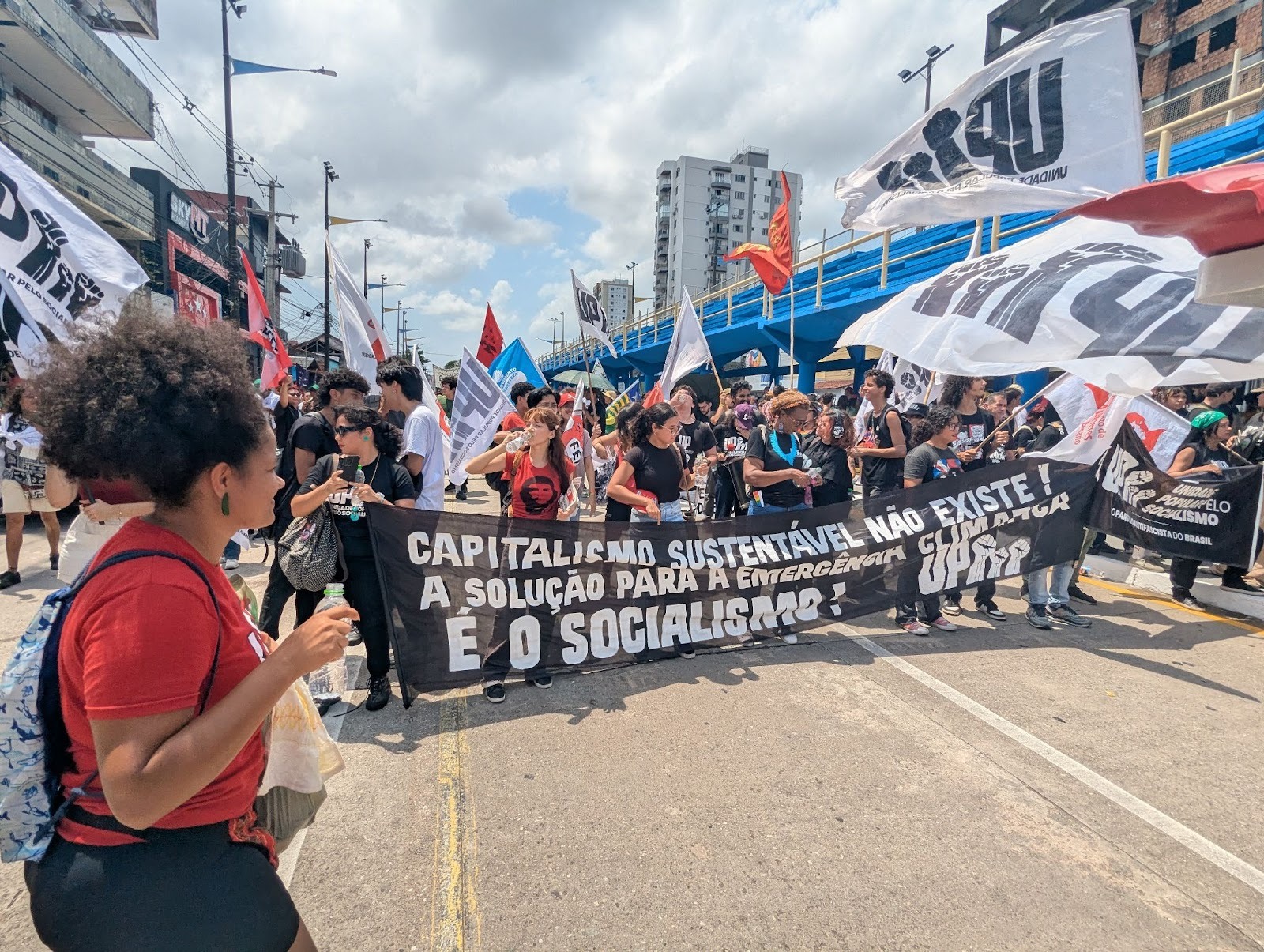
Young people wearing black and red clothing march through Belém do Pará carrying signs, a large one of which says, “Sustainable capitalism doesn’t exist! The solution to the climate emergency is socialism!” Other flags among the group mention the organization “Popular Unity towards Socialism.” Photo by the author.