MOVEMENT THEATRE WORKSHOP SOIREE: Thursday 5/2

MOVEMENT THEATRE WORKSHOP SOIREE
5pm, Thursday May 2
Tarble in Clothier (upstairs space)

Come see a series of short pieces created by students in this
semester’s Movement Theatre Workshop.  The pieces will include mask
work, a melodrama, tragic chorus pieces and other original works of
physical theatre created by the students during the semester.  Should
last no more than an hour. –Professor Quinn Bauriedel

MOVEMENT THEATRE WORKSHOP SOIREE: Thursday 5/2

MOVEMENT THEATRE WORKSHOP SOIREE
5pm, Thursday May 2
Tarble in Clothier (upstairs space)

Come see a series of short pieces created by students in this
semester’s Movement Theatre Workshop.  The pieces will include mask
work, a melodrama, tragic chorus pieces and other original works of
physical theatre created by the students during the semester.  Should
last no more than an hour. –Professor Quinn Bauriedel

Dance Works-in-Progress: 5/6 4:30PM

Monday, May 6th

4:30PM

LPAC Boyer (#003)
The ballet pointe repertory class will present a showing of four works that integrate pointe technique, musicality and performance quality.  The pieces include “Pas de Trois” from Petipa’s Swan Lake with music by Tchaikovsky, Jerome Robbins’ “2&3 Part Inventions” set to piano exercises of Bach, and the “Gold” and “Diamond” variations from Petipa’s Sleeping Beauty, also with music by Tchaikovsky.

and

Bryan Chen ’15 will also present his latest multimedia, experimental dance piece with puppetry in LPAC Troy (#002).

Please come support these student showings of some works in progress!

Dance Works-in-Progress: 5/6 4:30PM

Monday, May 6th

4:30PM

LPAC Boyer (#003)
The ballet pointe repertory class will present a showing of four works that integrate pointe technique, musicality and performance quality.  The pieces include “Pas de Trois” from Petipa’s Swan Lake with music by Tchaikovsky, Jerome Robbins’ “2&3 Part Inventions” set to piano exercises of Bach, and the “Gold” and “Diamond” variations from Petipa’s Sleeping Beauty, also with music by Tchaikovsky.

and

Bryan Chen ’15 will also present his latest multimedia, experimental dance piece with puppetry in LPAC Troy (#002).

Please come support these student showings of some works in progress!

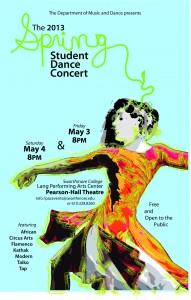
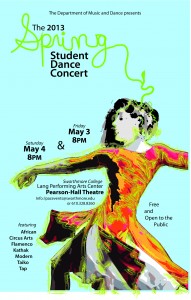
2013 Spring Student Dance Concert (5/3 + 5/4 @ 8PM)

2013SDCThe Swarthmore College Dance Program presents the 2013 Spring Student Dance Concert which features African, Circus Arts, Flamenco, Kathak, Modern, Taiko and Tap performances. There will be several pieces using live music. Come celebrate our graduating seniors and the hard work and creativity of all our dance students and faculty. The concert, which is appropriate for all ages, is free and open to the public.

LPAC Pearson-Hall Theatre
Swarthmore College

May 3 and 4 at 8PM

Info: lpacevents@swarthmore.edu

2013 Spring Student Dance Concert (5/3 + 5/4 @ 8PM)

2013SDCThe Swarthmore College Dance Program presents the 2013 Spring Student Dance Concert which features African, Circus Arts, Flamenco, Kathak, Modern, Taiko and Tap performances. There will be several pieces using live music. Come celebrate our graduating seniors and the hard work and creativity of all our dance students and faculty. The concert, which is appropriate for all ages, is free and open to the public.

LPAC Pearson-Hall Theatre
Swarthmore College

May 3 and 4 at 8PM

Info: lpacevents@swarthmore.edu

Original Earth Day Proclamation Arrives on Campus in Time for This Year’s Celebration

From Swarthmore News and Events:

Original Earth Day Proclamation Arrives on Campus in Time for This Year’s Celebration

by Mariam Zakhary ’13

April 22, 2013

Earth Day Proclamation (image)

The original Earth Day proclamation, above, was donated by the family of Earth Day originator John McConnell.

The original 1970 Earth Day Proclamation, signed by 35 international dignitaries, is now a permanent part of the Swarthmore College Peace Collection, thanks to a gift from the family of its author.

“John McConnell’s work for the last 50 years helped many to connect international peace with the need to preserve the environment,” says Wendy Chmielewski, the Collection’s George R. Cooley Curator, of the holiday’s founder. “McConnell reached many world leaders, as the Earth Day Proclamation shows, but his message also inspired ordinary people around the globe.”

In 1968, McConnell, a Presbyterian minister and peace activist from Iowa, designed the Earth Day flag showing planet Earth as seen from space. He proposed the idea of Earth Day the next year in order to celebrate a peaceful planet. McConnell also authored a second proclamation, the Star of Hope, with signatures from world scientists. That doucument, as well as a large collection ofMcConnell’s papers detailing his 50-plus years of work for world peace, is also part of the Collection.

The Earth Day proclamation is a poster-sized, hand-created, and hand-colored document. Among the 35 signators are anthropologist Margaret Mead, former Senator Eugene McCarthy, Nobel Prize-winning former President of Costa Rica Oscar Arias, Soviet leader Mikhail Gorbachev, and astronaut Buzz Aldrin. Earth Day is now celebrated internationally on the Vernal Equinox.

The Swarthmore College Peace Collection is one of the most extensive research libraries and archive collections in the country that focuses solely on movements for peace. The Collection’s holdings on the environmental movement span the papers and records of numerous peace organizations and activists who have worked for the benefit of the environment during the second half of the 20th-century and beyond.

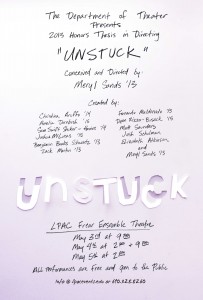
UNSTUCK, Honors Thesis in Directing (5/3-5/5/2013)

unstuck_poster_2swift UNSTUCK is a new story about memory, creation, and the reality of loss. Inspired by the works of Jorge Luis Borges, Salman Rushdie, David Mazzucchelli, and more, this is a collaboratively crafted tale of magical thinking collapsed into stark magical realism. Shadows dance around an artist and his sister as they push the boundaries of what makes our world physical.

Directed and Conceived by Meryl Sands ’13

and Featuring and Created by
Christina Aruffo ’14, Amelia Dornbush ’15, Sam Swift Shuker-Haines ’14, Joshua McLucas ’15, & Benjamin Books Schwartz ’13.

Stage Managed by Zack Martin ’13
with Set Design by Matt Saunders, Costume Design by Dyan Rizzo-Busack ’15, Lighting Design by Josh Schulman, Sound Design by Elizabeth Atkinson, & Projection/Media Design by Fernando Maldonado ’13

Showings:

May 3 and May 4 @ 9PM
May 4 and 5 @ 2PM

LPAC Frear Ensemble Theatre


New History courses may be counted toward Peace and Conflict Studies minor

Enrollment for fall courses is coming up on Monday, and we are happy to announce that, with the hire of a new faculty member in the History department, Rosie Bsheer, three new courses may be counted toward a minor in Peace and Conflict Studies.

Please note that the last course listed below may only be counted with special permission. See more information about special-permission courses at http://www.swarthmore.edu/academics/peace-and-conflict-studies/academic-program/courses-by-semester.xml

HIST 001N. First-Year Seminar: Oil and Empire

This course examines the political and social history of oil since the late nineteenth century, looking at oil’s impact on the rise and fall of empires, the fates of nation-states, its role in war, as well as its varied impact on social and cultural life. This course addresses global trends and processes, from Venezuela to Indonesia and the Niger Delta, but the primary focus will be on the Middle East.

Writing course.

1 credit.

Fall 2013. Bsheer.

May be counted toward a minor in Peace and Conflict Studies

HIST 017. Social Movements in the Arab World

May be counted toward a minor in Peace and Conflict Studies

HIST 006B. The Making of the Modern Middle East*

This survey course is designed at once to introduce students to the broader historical narratives and historiographical debates associated with major local, regional, and global events and processes that have most profoundly affected the political, social, cultural, and intellectual realities, past and present, of the modern Middle East. We will draw on readings from various disciplinary areas, including history, anthropology, politics, and literature.

1 credit.

Spring 2014. Bsheer.

This course can be counted toward a Peace and Conflict Studies minor with special permission.  See more information about special-permission courses at http://www.swarthmore.edu/academics/peace-and-conflict-studies/academic-program/courses-by-semester.xml

Tahrir Square

Photo: Amobasher CC license

Nimesh Ghimire ’15 Receives Davis Project for Peace Award to Strengthen Efforts in Nepal

From Swarthmore College News and Events.  See the original story at http://www.swarthmore.edu/news-and-events/nimesh-ghimire-15-receives-davis-project-for-peace-award.xml
by Erin Kelly
April 12, 2013
Peace Innovation Lab

The Peace Innovation Lab in Sahilitar, a rural village in western Nepal.

Nimesh Ghimire ’15 is the recipient of a Davis Project for Peace Award that will allow him to direct, establish, and strengthen the recently launchedPeace Innovation Lab (PIL) at Shree Gyanodaya Higher Secondary School in Sahilitar, a rural village in western Nepal. The project also includes a weeklong Peace Innovation Camp.

The award will help build on the Peace Innovation Lab model and take it to its next level, according to Ghimire.

“The Peace Innovation Lab is a creative space for young people in rural communities to come together to design, prototype, and implement interesting projects that contribute to local peace-building and grassroots innovation efforts,” says Ghimire, who is collaborating with Mahabir Pun, winner of the Ramon Magasaysay Award (commonly called the Asian Nobel Prize), to set up a wireless internet network needed to establish the peace-building projects.

According to Ghimire, the PIL will strive to encourage continued participation in Nepali peace-building affairs and assist with the rebuilding of Nepal’s public education system. One of the outcomes of the weeklong Peace Innovation Camp is that the students will come up with at least five projects for implementation in their local village over the following months.

“During the decade-long civil war, a lot of young students in rural Nepali communities were directly involved,” Ghimere says. “After the active war ended in 2006, these young students have very little or no involvement in the peace building process. PIL’s vision is to engage young people into the peace building process and leverage their creative insight into solving local (peace building) challenges.”

Ghimire adds that a complicating factor is Nepal’s “broken” public education system. “There is too much focus on rote learning and not much emphasis on innovation, creativity, entrepreneurship and impact,” he says. “PIL’s vision is to promote itself as an innovation hub, integrated into the local public school, allowing young students to use the space as a place to create, tinker, explore, and connect.”

The Davis Projects for Peace awards more than $1.2 million in $10,000 grants to students who submit proposals for 2013 summer projects. The grant is named for philanthropist Kathryn W. Davis and funds projects that address conflict resolution and reconciliation, foster understanding, provide opportunity, and build community.

“This project will allow us to connect this rural corner of Nepal and the students to the global village,” Ghimiere says, “make different online resources available to the entire village as well as introduce a couple of revenue models – an internet cafe and a basic telemedicine hub – to generate some money for the Lab’s resource requirements. I want to help people launch some initiatives that will bring new energy and ideas to the prospects of peace in the world.”

The project is further supported with seed funding from Global Changemakers, a program managed by the British Council.